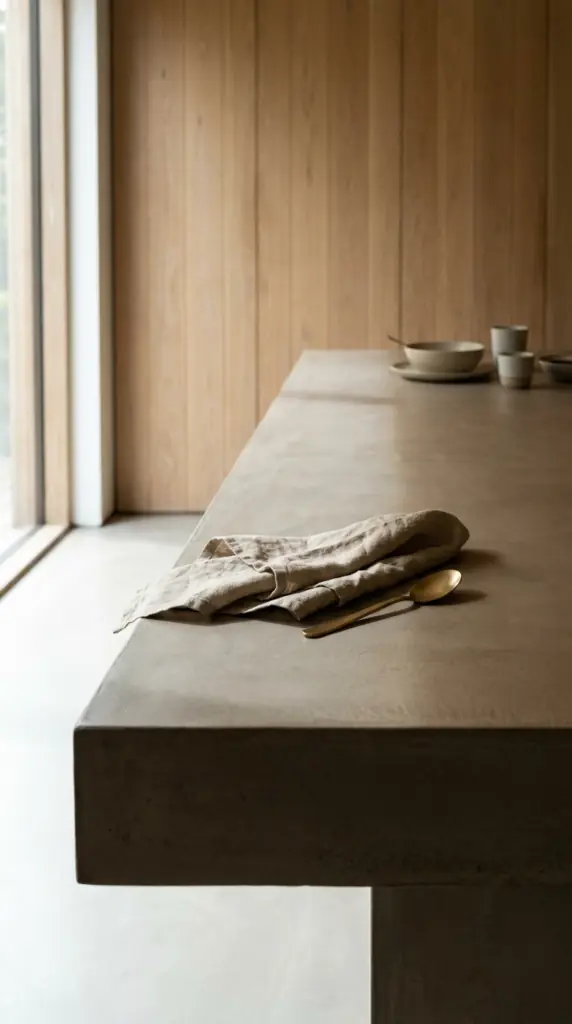
The Dining Monolith: Solving the “Empty Banquet” Paradox
The Architectural Problem: The Abandoned Conference RoomOne of the most persistent failures in luxury open-plan design is “The Empty Banquet.” In an effort to signal wealth and hosting capacity, massive, freestanding dining tables are placed in the center of the room. However, when these 12-seat tables are not actively hosting a dinner party—which is 95% of the time—they become visual dead weight. They look like abandoned corporate conference tables, draining the intimacy and warmth out of the sanctuary. The challenge was to create a dining space that scales perfectly: feeling grand when hosting, yet fiercely intimate when sitting alone.
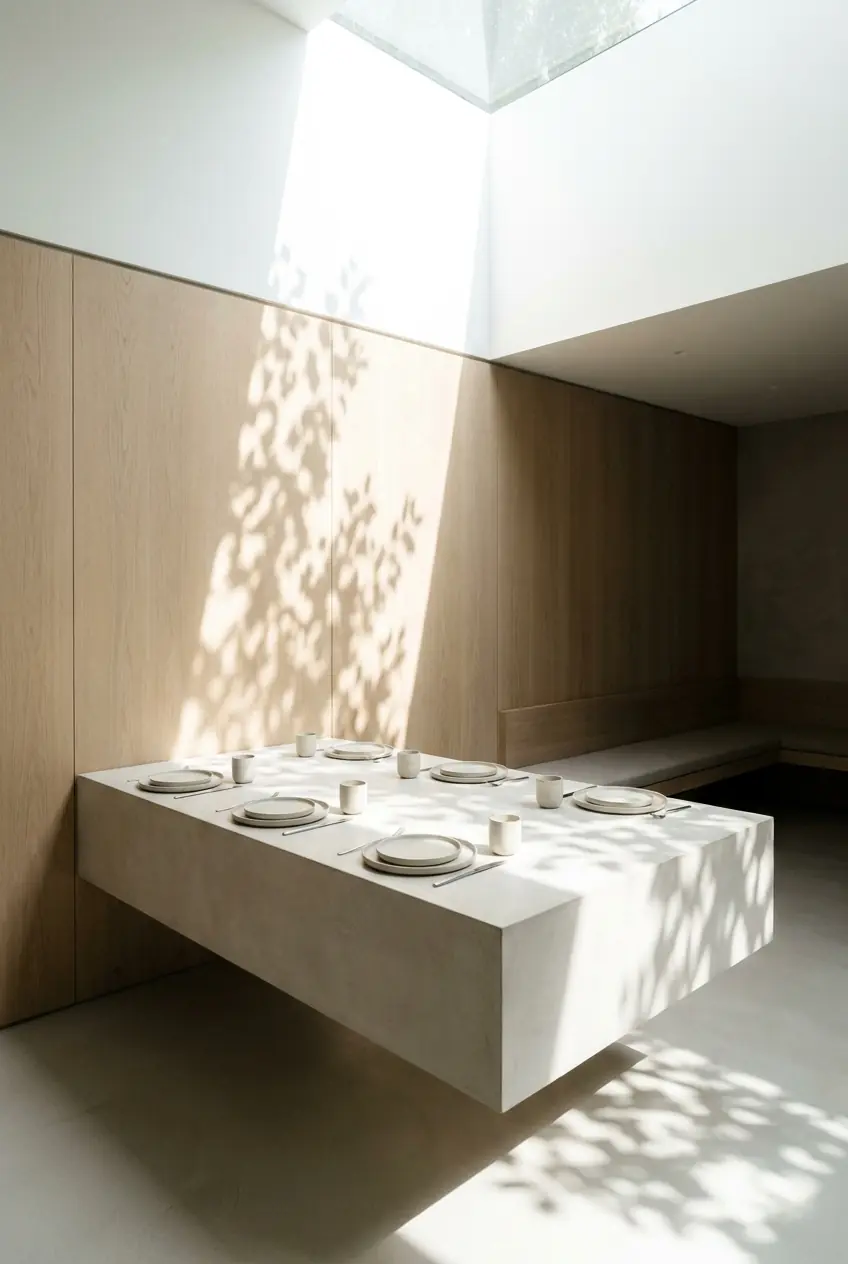
The Solution: The Cantilevered Architectural Plinth
To solve the “Empty Banquet” paradox, we completely rejected the concept of freestanding furniture. The solution is The Dining Monolith. Rather than buying a table, we engineered a massive, cantilevered dining plinth carved entirely from pale Seamless Microcement. This plinth emerges directly from a structural wall clad in Scandinavian White Oak. By attaching the dining surface to the architecture of the home itself, it ceases to be “furniture waiting for people” and becomes a permanent, sculptural feature of the room. The lack of legs creates a floating void underneath, reducing visual clutter and maximizing the perception of space.
The 70/30 Solar Saturation Protocol
Architectural mass requires brilliant light physics to prevent the space from feeling heavy or oppressive. We engineered the room using the 70/30 Solar Saturation rule. We allowed 70% of the room to be flooded with high-key, pure daylight, specifically filtering it to create dappled Komorebi leaf-shadows across the pale cement. The remaining 30% of the space is held in soft, grounding structural shadow near the oak joinery. This high-contrast ratio ensures the monolithic table feels bright and alive during the day, rather than cold and sterile.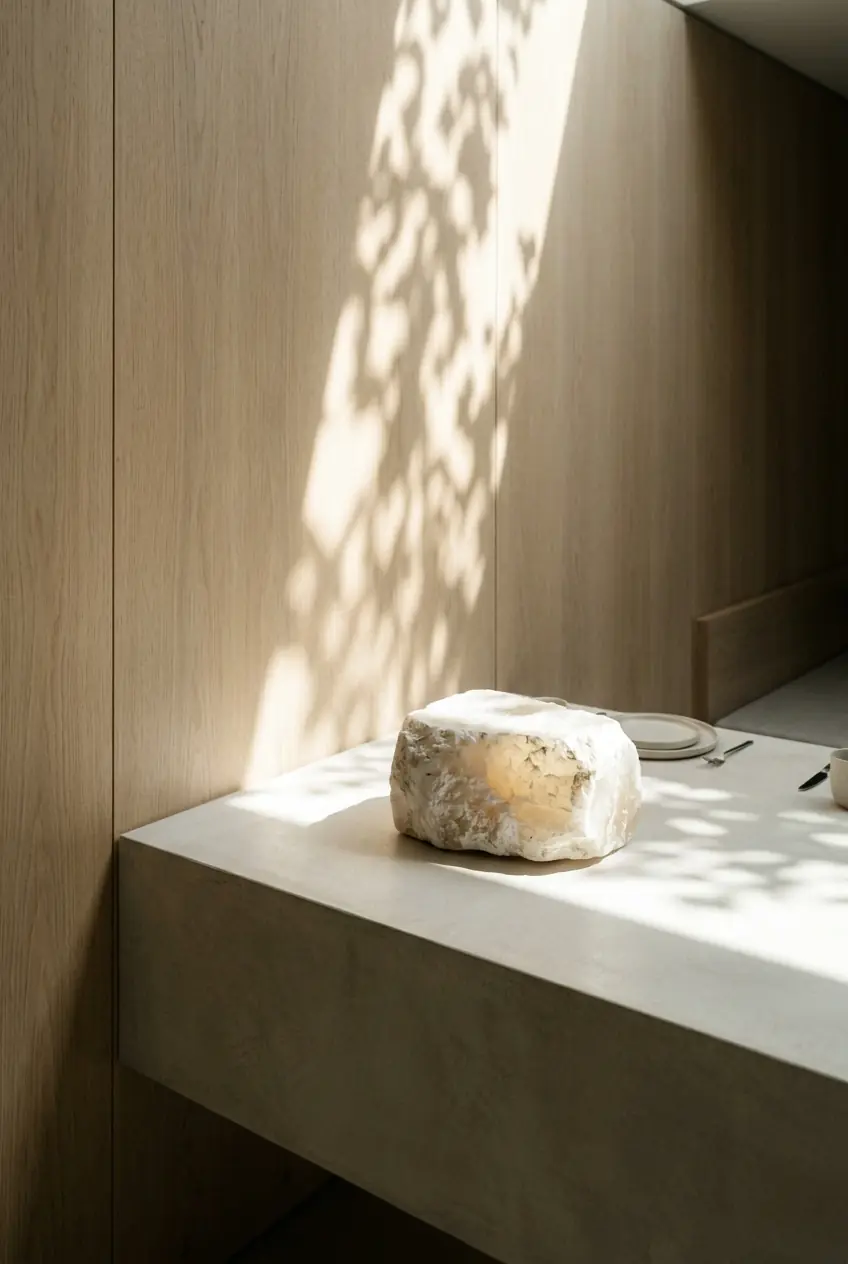
Tactile Anchoring: The 10.5mm Boundary
To finalize the solution, we needed to give the eye a resting place—a tactile anchor that brings human scale back to the massive concrete plinth. We introduced a large, rough-hewn Raw Alabaster centerpiece. At the exact 10.5mm intersection where the glowing, internally refractive edge of the alabaster touches the velvety, dead-matte microcement, we achieve profound tactile friction. The fierce 70% daylight hits the alabaster, turning it into a brilliant “Light-Catcher,” while casting sharp micro-shadows across the non-reflective cement foundation.The ResultThe Dining Monolith proves that scale does not have to sacrifice intimacy. By replacing freestanding tables with cantilevered architectural joinery, and balancing heavy microcement with brilliant 70/30 daylight, we solved the “Empty Banquet” paradox. The result is a dining space that feels monumental when hosting, and perfectly restorative when enjoying a quiet morning coffee.